

Friday Footnotes: Musical collabs, destructive inventors, and the weirdest Olympics
A collection of things I learned or found interesting recently

Welcome to this week’s Friday Footnotes.
I had a few questions this week about the National Quiz Day and what other events are in the quizzing calendar here in Australia. You can check out the main calendar of events and find more info on the Quizzing Australia website, and its FAQ page. And you can buy past question sets from the Quizzing Australia Online Store if you’d like to have a go at some previous quizzes.
I’m also working on a big Resources post which will list what’s out there in the quizzing world, both online and in person. It’s what I wished existed when I first started trying to get more involved in 2022.
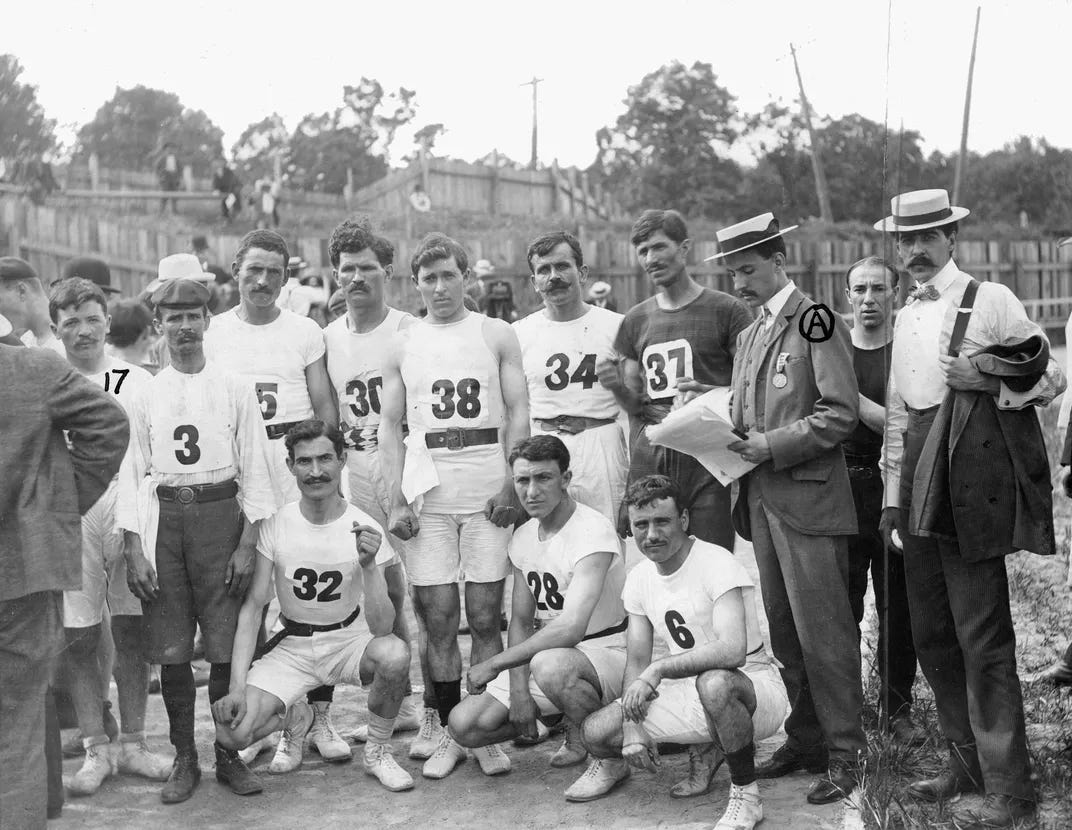
Last week I asked you about the 1904 St. Louis Olympics. It was a bizarre Olympics by modern standards, and perhaps the strangest event of all was the men’s marathon1. Of the 32 athletes who competed, only 14 completed the race. Competitors included two men from the Tswana tribe in South Africa, the first Black Africans to participate in the Olympic Games, and Cuban Félix Carvajal, a former mailman who raised money to attend by demonstrating his running ability in Cuba. But then after arriving in New Orleans, he lost all his money in a dice game and had to walk and hitchhike the rest of the way to St. Louis.
There was only one water station along the whole 24-mile course, which was at the 12-mile point, because the chief organiser of the Games wanted to test the effects of dehydration. One runner nearly died after the dust from the roads ripped his stomach lining, and another gave up after a bout of vomiting. Len Tau, one of the South African runners, was chased a mile off course by a wild dog. Another runner took a nap after eating some spoiled apples along the way, and still finished fourth. The first to finish was later disqualified as it turned out he hitched a ride in a car for a large portion of the race. The eventual winner, Thomas Hicks, nearly didn’t make it either. His team fed him a concoction of egg whites and the poison strychnine(!) throughout, with some brandy to wash it down. By the end, he was hallucinating and slack-jawed, and after finishing, it took him four hours to recover enough to leave the stadium.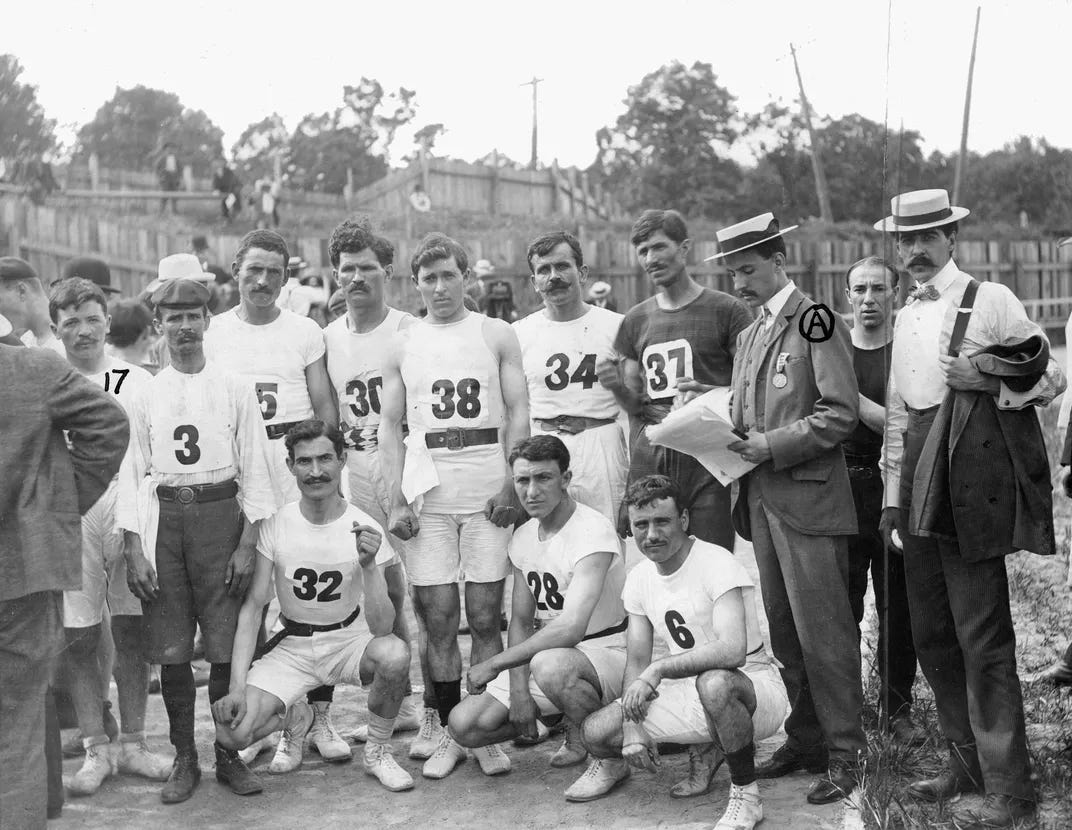
Some of the athletes competing in the 1904 marathon One of the most remarkable athletes of the St. Louis Games was George Eyser, a German-American gymnast who won six medals in a single day, including three gold, in the vault, rope climbing, and parallel bars. He did all of this despite competing with a wooden leg! He had lost his leg in his youth, apparently after being run over by a train (though this story is disputed). His gold in the vault is particularly impressive as it involved jumping without the aid of a springboard.
Eyser is not the only amputee to compete at an Olympic Games. More recently, South African swimmer Natalie du Toit competed in the Beijing Olympics in 2008, finishing 16th in the 10km swim. At 17, her left leg was amputated at the knee after she was hit by a car riding her scooter back to school from swimming training. She also competed at the Paralympic Games in the same year, winning five gold medals, and carried the flag at the Opening Ceremony of both events, making her the first athlete to carry a flag at an Olympic and Paralympic Games in a single year.
Returning also to Victorian gothic horror, a story from Leo Damrosch’s biography of Robert Louis Stevenson suggests that the greatness of The Strange Case of Dr. Jekyll and Mr. Hyde is largely down to Stevenson’s wife Fanny. From The Hudson Review:
When Louis read aloud his first draft, as Fanny’s son Lloyd recalled, “Her praise was constrained; the words seemed to come with difficulty; and then all at once she broke out with criticism. He had missed the point, she said; had missed the allegory; had made it merely a story—a magnificent bit of sensationalism—when it should have been a masterpiece.” Damrosch continues, “Fanny’s point was that Louis had ruined the story by turning it into a mere tale about a secret life. . . . What was needed was not just a character wearing a disguise, but something far more profound: a character struggling with a deeper hidden self that breaks loose and fights for supremacy.” Louis resisted, then came around, went back to work, and gave her the masterpiece she wanted. Thereafter, he jokingly referred to her as “the critic on the hearth.”I also read about American mechanical and chemical engineer Thomas Midgley Jr (1889-1944), who historian J.R. McNeill described as having “more adverse impact on the atmosphere than any other single organism in Earth’s history.” Midgley played a major role in developing leaded gasoline, discovering that adding tetraethyllead preventing knocking in internal combustion engines. After moving to another team, partly due to health issues resulting from lead poisoning (surprise), he then devised a replacement for ammonia in refrigerator cooling systems: Freon, the first CFC… Oof.
While his song Lose Control became the first song in history to spend triple-digit weeks on the Billboard Hot 100, American singer Teddy Swims said his real “made it” moment came ten days after performing at the NRL Grand Final, when he got to collaborate and perform at a show with his “heroes growing up”… The Wiggles. Together they played a medley of Rock-A-Bye Your Bear, Hot Potato, and Fruit Salad!
More info in this excellent read from the Smithsonian Magazine.