Friday Footnotes: High-achieving relatives and Italian-American connections
A collection of things I learned or found interesting recently

Welcome to this week’s Friday Footnotes.
As I said last week, this format is a bit less structured and is a chance for me to share things I’ve learned or found interesting recently without trying to wrangle them into question form as part of a quiz. It’s the sort of thing I enjoy reading, so I hope you do too!
Actor Paul Giamatti’s father was the seventh Major League Baseball Commissioner. Angelo Bartlett (‘Bart’) Giamatti served as Commissioner for exactly five months before dying suddenly from a massive heart attack at his home on Martha’s Vineyard, aged 51. His brief tenure saw the permanent banning of Cincinnati Reds great Pete Rose from baseball after accusations of gambling on matches, including Reds games while he was the manager. Giamatti was also a professor of English Renaissance Literature at Yale, with a focus on Edmund Spenser, and he served as president of Yale University from 1978-1986, the youngest president in its history.
The Bank of America was originally called the Bank of Italy. It was founded in 1904 in San Francisco by Amadeo Pietro Giannini as the Bank of Italy. After the 1906 earthquake in the city and ensuing fires, Giannini filled the bank assets in a horse-drawn cart and drove them to his home. It was one of the first banks to offer loans to businesses for rebuilding the city. In 1930, the name was changed from Bank of Italy to Bank of America, and by 1945, it was world’s largest commercial bank.
On the San Francisco earthquake of 1906, it is estimated that 80-95% of the total destruction came from the fires that burned out of control afterwards rather than the earthquake and aftershocks. At the time, the widespread practice from insurers was to cover property damage from fire, but not from earthquake damage, and there are reports that some property owners deliberately set fire to their damaged properties so they could claim insurance. Fires raged for several days.
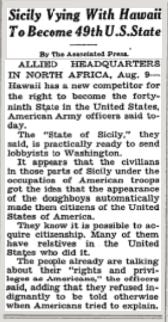
There was a movement during and shortly after WWII for Sicily to become a US state. There was a growing separatist movement in Sicily that felt underrepresented and wanted independence from Italy, also campaigning for it to become the 49th US state (before Alaska and Hawaii). In 1947, the Movement for the Independence of Sicily gained 8.8% of the votes in the regional election. Below is an article in the New York Times from August, 1943:
Lots of Nobel Prize chatter with the 2025 prizes being announced this week, which reminded me of some interesting family connections. 1922 Physics Nobel laureate Niels Bohr was a keen footballer who played as a goalkeeper for Akademisk Boldklub in Copenhagen. According to a 1989 history of the club, during one match, a long ball was kicked towards Bohr’s goal, but he did not notice until a spectator shouted at him, by which point the ball had already gone into the goal. After the game, he admitted he was thinking about a mathematical problem and making calculations on the inside of the goalpost. Bohr’s mathematician brother Harald played football too, and represented the Danish national team, winning a silver medal at the 1908 Olympics in London. Niels Bohr’s son Ernest also represented Denmark at the Olympics, in the field hockey team in 1948 in London.
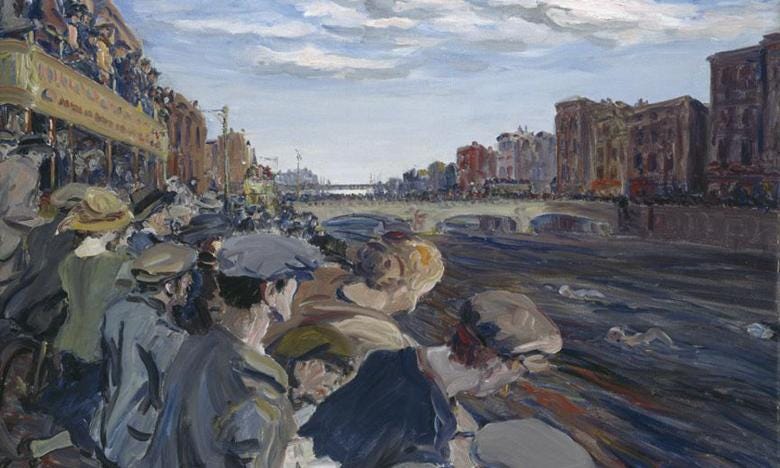
Bohr is not the only Nobel laureate with an Olympic medallist sibling. Irish poet WB Yeats won the 1923 Nobel in Literature. His younger brother, Jack Butler Yeats, was a painter and won a silver medal in the Painting competition at the 1924 Paris Olympics. Yes, they had art competitions at the Summer Olympics between 1912-1948, for works of art inspired by sport across five categories: architecture, literature, music, painting, and sculpture. Yeats’s painting The Liffey Swim (below) made him the first Olympic medallist representing Ireland, after Irish independence in 1922.
A more recent example is Susan Francia, who won gold medals for the USA in the women’s eight rowing in 2008 and 2012. She is the daughter of Hungarian biochemist Katalin Karikó, who won the 2023 Nobel Prize in Physiology or Medicine for her research on mRNA.
All this reading led me to learn about Australian John Cornforth, the only Nobel laureate born in Sydney. Cornforth began to lose his hearing during childhood, and was completely deaf by age 20. Unable to hear his lectures at the University of Sydney, he read chemistry textbooks by himself. His work on the stereochemistry of enzyme catalysts in organic compounds eventually led to the development of cholesterol-lowering drugs. He won the Nobel Prize in Chemistry in 1975 alongside Vladimir Prelog, and was named Australian of the Year in the same year.
Cornforth’s brother Roger was an all-round athlete, with a state junior hurdles title in 1937 and a national 200m breaststroke title two years later. After joining the army in 1940, he was captured and spent some years in a POW camp. After the war, he switched to rugby and represented Australia in 1947 and 1949 against New Zealand, and in 1950 against the British Lions. He also played water polo, and represented Australia in the men’s tournament at the 1948 Olympics in London!
Englishman Philip Noel-Baker is the only person to win an Olympic medal and a Nobel Prize. He won silver in the 1500m in 1920 in Antwerp, and won the 1959 Nobel Peace Prize for his work campaigning for nuclear disarmament.